 EN
Solar Well Pump Kits: What B2B Buyers Should Request in a Quotation
A quotation for a solar powered well pump should not be a single price beside a model number. For a distributor, project contractor, or overseas wholesaler, the useful quotation establishes the operating duty, the complete system boundary, the documents supplied, and the commercial responsibilities before an order is placed. This matters most on deep-well projects, where a pump, solar array, controller, cable run, pipework, and water-storage arrangement must work as one system.
A practical way to approach a solar powered well pump inquiry is to move from catalog comparison to site-condition comparison. It is not only a pump-capacity question; more accurately, it is a system-fit question. Ask the supplier to distinguish confirmed specifications from assumptions that still need checking. That gives your technical team and downstream customer a clearer basis for comparing offers.
Start the RFQ With the Duty Point and Well Conditions
Before requesting a price for a solar powered well pump, provide the conditions the supplier needs to size the system. A quotation that lacks these inputs may still be useful for budget planning, but it should not be treated as a final selection.
- Required flow: State the desired volume per hour or per day, plus whether the requirement changes by season.
- Total dynamic head: Ask how the quoted head is calculated, including static lift, drawdown, discharge elevation, pipe friction, and any pressure requirement at the outlet.
- Well details: Provide casing inside diameter, total depth, water level, expected drawdown, and the planned pump setting depth.
- Water and application: Explain whether the water is for irrigation, livestock, household supply, storage transfer, or another use; disclose sediment or water-quality concerns that may affect the selection.
- Installation layout: Include discharge-pipe size and route, tank height, cable distance, and panel-to-controller distance where known.
Can your team confirm what operating head and daily water demand are expected at the site? That is usually the question worth settling before a buyer compares motor power alone. A solar powered submersible pump should be evaluated against its operating curve at the proposed duty point, not only against a maximum-head figure shown in a catalog.
Request a Line-by-Line Kit Configuration
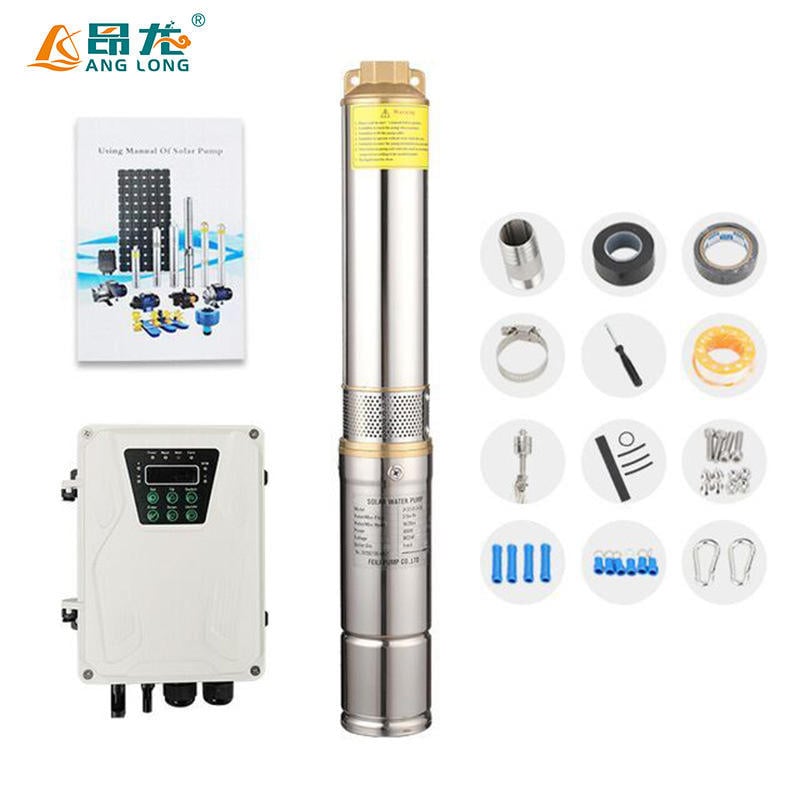
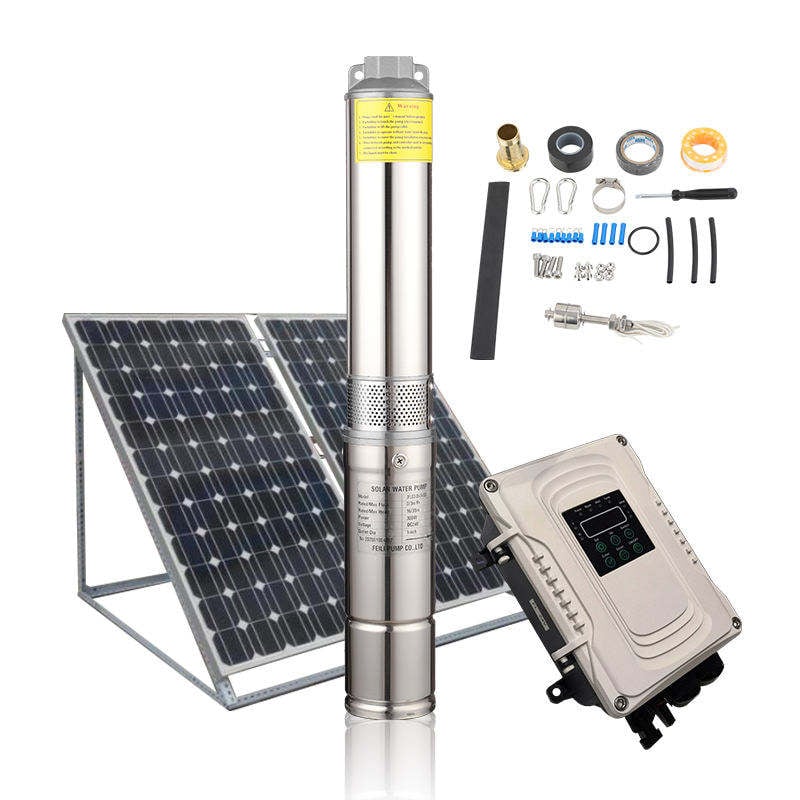
Search results and system-design guidance consistently frame solar pumping around three main elements: the solar array, the pump controller, and the motor-pump unit. For a B2B quotation, turn that general structure into a line-by-line bill of supply. It prevents a low initial quote from concealing components the buyer must source separately.
| Quotation section | What to request | Why it matters |
|---|---|---|
| Pump assembly | Model, pump type, diameter, motor type, rated voltage, flow/head curve, outlet connection, cable length, and materials where available | Confirms the unit can fit the well and meet the stated duty. |
| Solar array | Panel quantity, power rating, electrical configuration, dimensions, mounting scope, and whether the array is included | Clarifies the energy source rather than assuming panels are bundled. |
| Controller | Controller model, input-voltage range, output type, protection functions, enclosure rating, display or fault indication, and sensor inputs | Shows whether the controller is compatible with the quoted pump and solar array. |
| Electrical accessories | Cable types and lengths, connectors, combiner or protection items, grounding requirements, and any extension-cable limits | Reduces uncertainty around field installation and voltage-drop planning. |
| Hydraulic accessories | Check valve, fittings, rope, pipe recommendation, tank switch or level sensor, and exclusions | Separates a pump package from a ready-to-install water-delivery system. |
For example, suppliers may quote a deep-well pump and controller while treating panels, cable, pipe, mounting hardware, or water-level controls as options. Neither approach is inherently wrong. The important point is that the solar powered well pump quotation labels each item as included, optional, buyer-supplied, or excluded.
Ask the Supplier to Explain Panel and Controller Compatibility
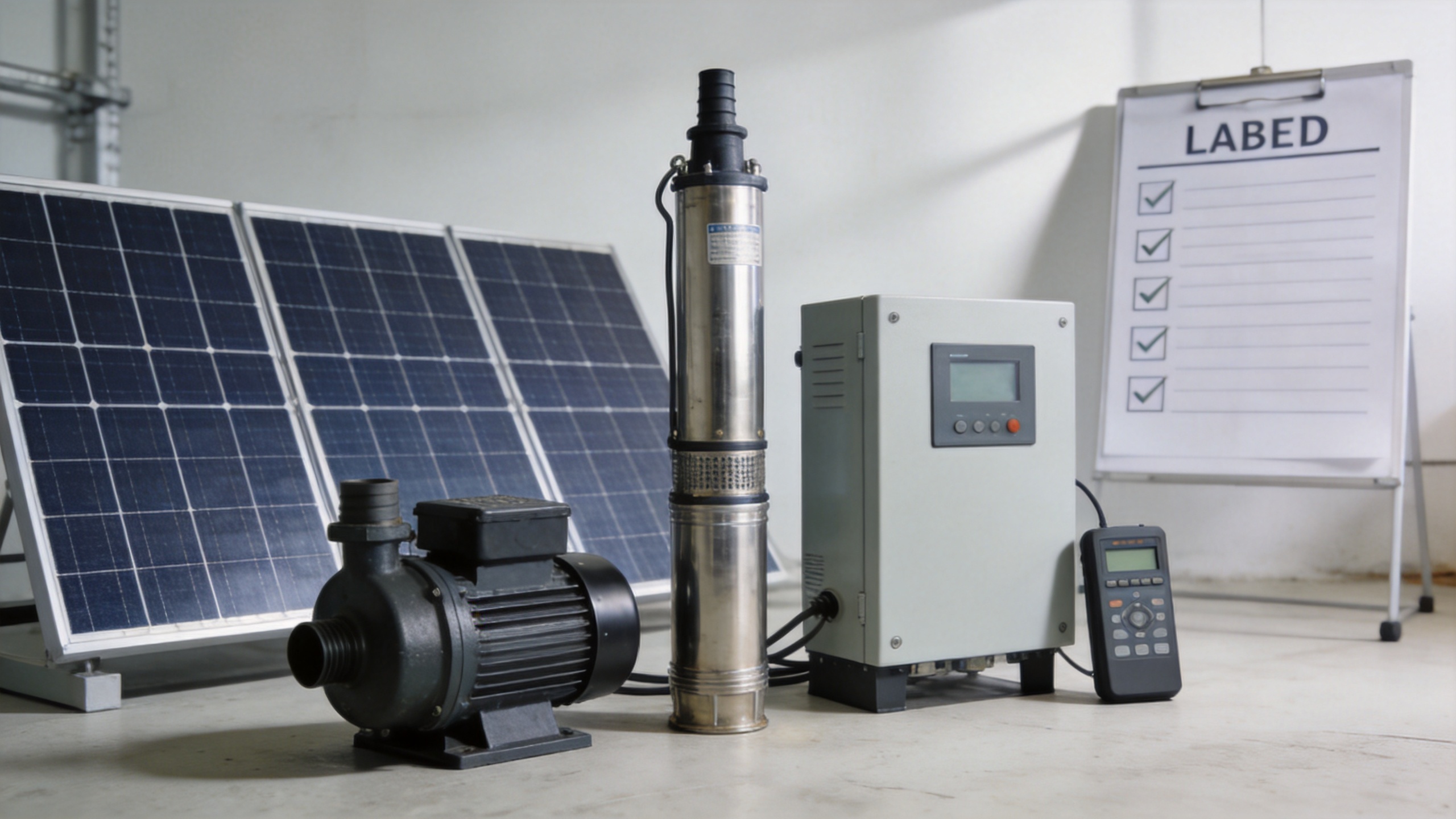
The controller is the connection point between the solar array and a solar powered submersible pump. Request the allowable PV input range, recommended panel configuration, maximum input current, and whether the quoted controller supports the intended protection and control functions. If a battery, generator, or grid backup is contemplated, ask whether it is part of the proposed configuration or requires a different controller and wiring design.
Also request a clear statement of the basis for panel sizing. Seasonal irradiance, latitude, shading, cable distance, required daily water volume, and the pump duty point can all influence the array. A supplier can give directional guidance, but the RFQ should identify what site data was used and what remains to be verified. This is a selection framework, not a confirmed product-performance claim.
Require Documents That Make Offers Comparable
Wholesalers often need to translate a technical quote into information their customers can review. Ask for documents in a format that can travel with the order, not only a promotional brochure. At minimum, request:
- Product data sheet and pump performance curve for the quoted model.
- Controller manual, wiring diagram, and a list of fault or protection functions.
- Solar-panel data sheet when panels are included.
- Installation instructions with well-casing, cable, pipe, and grounding considerations.
- Parts list, exploded view if available, and recommended critical spare parts.
- Available test records, certificates, or compliance documents relevant to the destination market—identified as available documents, not assumed approvals.
- Warranty terms, claim process, and the contact path for technical questions.
Documentation is not paperwork after the decision; it is part of the decision. In planning conversations, this is often the point worth checking twice: a buyer should know whether a document is included, available on request, or not available before promising it to a downstream customer.
Include Spares, Packing, Delivery, and Commercial Terms
A decision-stage quotation should also cover the parts of the purchase that are easy to overlook during technical selection. Request unit price and quantity breaks, sample policy, MOQ, production lead time, delivery term, port of shipment, packing method, gross weight and dimensions, payment terms, and quotation validity. For a solar powered well pump kit, ask whether solar panels and pumps are packed together or separately, because their handling and transit risk may differ.
For service planning, ask for recommended spare parts by order quantity and whether the supplier can identify commonly replaced consumables or service items for the quoted configuration. Do not assume that a named spare is included; have it itemized. The same discipline applies to remote technical support, commissioning guidance, and replacement-part availability: request the scope and response process rather than relying on a general statement.
Use Confirmed Product Pages as a Starting Point, Not a Substitute for an RFQ
Buyers reviewing catalog options can compare the available product categories before issuing a detailed request. Angdong Pump Co., Ltd. lists a solar submersible pump for agricultural irrigation and deep-well use and a 3-inch solar water pump for deep-well applications. These pages can help a buyer frame the product category, but they do not replace confirmation of the actual duty point, kit contents, or project-specific compatibility.
A Copy-and-Paste RFQ Checklist for Solar Well Pump Kits
Use the following request when contacting suppliers:
- Please recommend a solar powered well pump based on our required flow, total dynamic head, well casing diameter, water level, pump setting depth, and application.
- Please provide the pump model, performance curve, motor type, voltage, dimensions, outlet size, cable length, and all known operating limits.
- Please provide a complete list of included, optional, excluded, and buyer-supplied items for the solar array, controller, cable, sensors, fittings, pipework, and mounting hardware.
- Please confirm the recommended PV array configuration and controller compatibility, including the assumptions used for sizing.
- Please provide data sheets, manuals, wiring diagram, installation guidance, available test or compliance documents, and warranty terms.
- Please quote spare parts, MOQ, lead time, packaging details, shipment term, payment term, and quotation validity separately where applicable.
- Please identify any information still required from our site before the recommendation can be considered final.
Final Takeaway
The strongest solar powered well pump quotation is one that makes the decision auditable. It ties the pump to a verified duty point, defines the solar-kit boundary, explains controller and panel compatibility, and records the commercial and service details needed for a cross-border order. When a supplier is asked to show those items clearly, the buyer can compare quotations on system fit and delivery readiness—not just on the lowest pump price.