 EN
Pressure Pumps for Water Tanks: Procurement Checklist for Projects
Buying pressure pumps for water tanks for a project is not mainly a catalogue exercise. The useful starting point is the duty point: how much water must be delivered, at what pressure, for how long, and under what tank and pipe conditions. From a pump-selection perspective, pressure pumps for water tanks should be compared only after those conditions are written down.
For a contractor, distributor, or procurement team, the goal is a repeatable decision. This checklist helps you request comparable data from suppliers, identify installation risks before delivery, and avoid treating a nominal power rating as proof of system fit. An inline pump for water may be appropriate in some layouts, but the system—not the product label—decides that.
1. Define the operating duty before requesting pressure pumps for water tanks
The first RFQ should describe the water source, tank level range, target outlet pressure, required flow, operating hours, and number of simultaneous users or outlets. These details turn a broad request for pressure pumps for water tanks into a duty-point question a supplier can answer with a curve.
Ask the project engineer to record:
- Minimum and maximum water level in the tank;
- Required flow rate at the critical outlet, not only total daily water demand;
- Required residual pressure at that outlet;
- Elevation difference from tank water level to the highest or most remote point;
- Pipe diameter, approximate route length, fittings, valves, filters, and meters;
- Water temperature, solids risk, and whether the water is clean or treated.
This is where many comparisons go wrong. Rather than starting with a model label, start with the circulation duty and system conditions. Pressure pumps for water tanks need enough head at the required flow; a high shut-off head by itself is not the required proof.
2. Convert the project data into a head-and-flow specification
For pressure pumps for water tanks, total dynamic head is a practical framework: static lift, pipe friction, and the pressure required at the delivery point all contribute to the duty. Friction losses change with flow and pipe layout, so the team should not copy a value from another site without checking the route.
| Specification item | What to provide | Why procurement needs it |
|---|---|---|
| Duty flow | Minimum, normal, and peak flow | Shows where pressure pumps for water tanks must operate on the curve. |
| Duty head | Static lift, friction allowance, and target delivery pressure | Prevents comparison by motor power alone. |
| Operating pattern | Continuous, intermittent, or variable demand | Guides control and tank-sizing discussion. |
| Electrical supply | Voltage, phase, frequency, and protection requirements | Confirms the motor and controller can be specified correctly. |
Request a pump curve with the proposed operating point marked on it. For pressure pumps for water tanks, also ask what assumptions were used for liquid condition and speed. If a variable-speed control is proposed, clarify the pressure setpoint range and the response expected as demand changes.
3. Check tank outlet and suction conditions
The tank and suction line deserve as much attention as the discharge side. Pressure pumps for water tanks can face unstable inlet conditions when the water level falls, the inlet line is restrictive, or fittings add unnecessary losses. It may be worth pausing here to confirm the fluid and temperature range, as well as the lowest expected tank level.
Review whether the pump has flooded suction, the distance between tank outlet and pump inlet, inlet pipe diameter, isolation arrangements, and the placement of strainers or foot valves. The available inlet pressure margin should remain appropriate for the pump’s stated requirement; inadequate margin can contribute to cavitation. That said, the next question is whether the piping condition supports that choice, not whether the pump has an attractive nominal rating.
For pressure pumps for water tanks, ask suppliers to state any suction-side limitations they need confirmed. A clear answer is more useful than an unqualified assurance that the pump will work with every tank.
4. Choose the control approach and protection functions
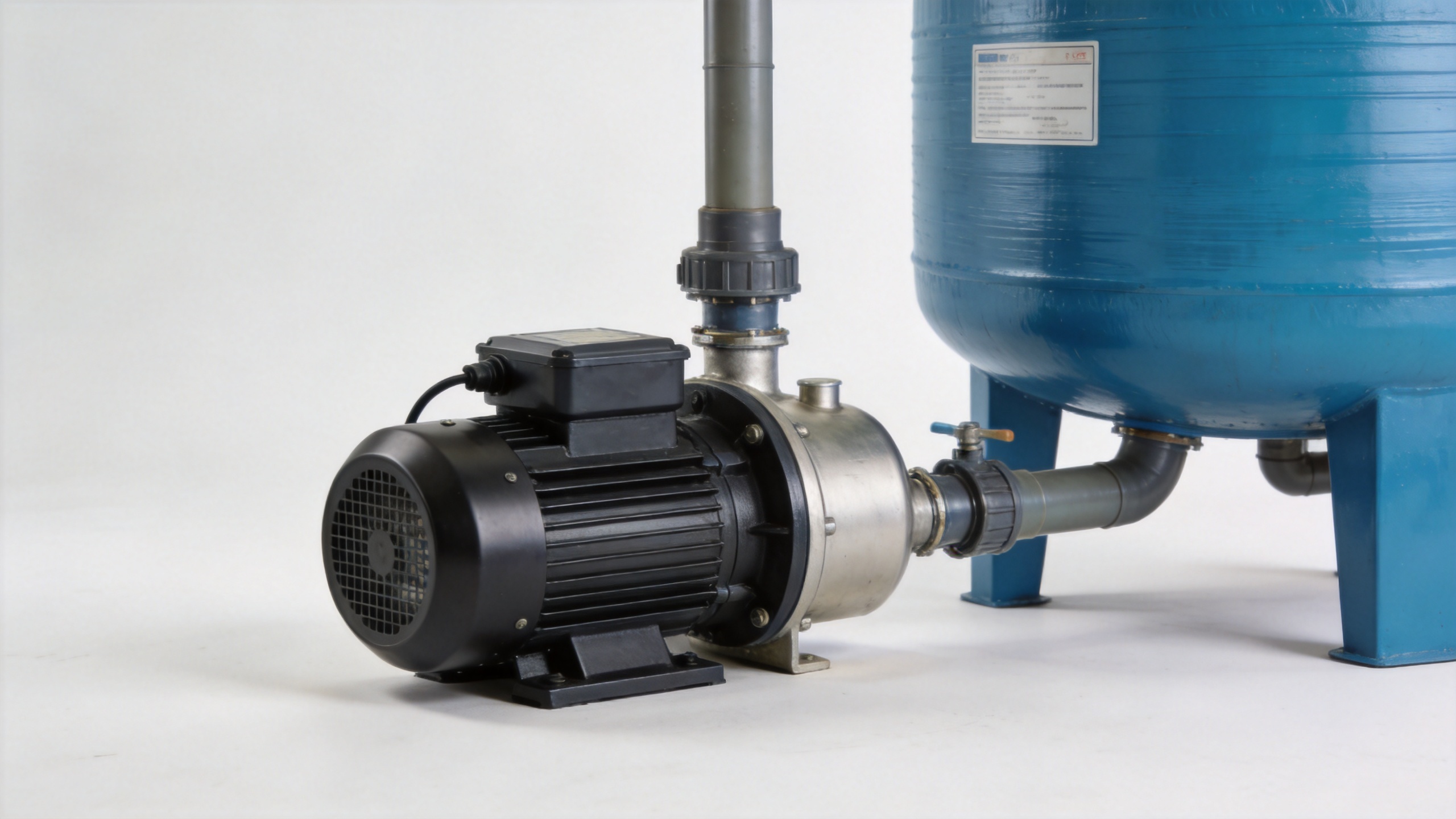
Pressure pumps for water tanks are often evaluated as equipment only, while pressure stability and pump life depend on controls. The project should decide whether it needs simple pressure switching, a pressure vessel arrangement, variable-speed control, duty/standby alternation, or a packaged booster arrangement.
- Low-water protection: define what happens when the tank reaches its minimum operating level.
- Dry-run protection: confirm the sensing method and reset behavior.
- Pressure control: state the cut-in/cut-out or setpoint range and tolerance needed by the application.
- Overload and phase protection: align this with the available electrical supply.
- Redundancy: define whether one pump can carry the required duty during maintenance.
These controls are part of the procurement scope for pressure pumps for water tanks; they should not be left as assumptions between the pump vendor, panel builder, and installer.
5. Compare suppliers using verifiable documents
At the decision stage, a supplier comparison should test documentation quality as well as price. Ask each bidder for a data sheet, performance curve, dimensional drawing, motor and controller information, material statement where relevant, installation manual, spare-parts list, warranty terms, and recommended commissioning checks.
Where the configuration is appropriate to the confirmed duty, you can discuss a product such as High Building Pressurized Stainless Steel Cast Iron Electric Jockey Water Pump For Water Circulation with the supplier. The product page should be treated as a starting point for technical discussion, not as proof that it fits every water-tank project.
Use the same submission template for every quotation. For pressure pumps for water tanks, this makes it easier to see when one quote includes controls, protection, or commissioning support that another quote leaves out.
6. Project procurement checklist before purchase order release
- Confirm flow, duty head, pressure requirement, and operating profile.
- Verify the selected duty point against the supplier’s pump curve.
- Confirm minimum tank level, suction route, and inlet-condition assumptions.
- Match motor voltage, phase, frequency, protection, and site control interface.
- Define dry-run, low-water, overload, and pressure-control functions.
- Check dimensions, service clearance, base arrangement, and pipe connection sizes.
- List required documents, factory checks, packing requirements, spares, and delivery terms.
- Agree on commissioning data to record after installation.
This checklist turns pressure pumps for water tanks from a broad buying request into a controlled project package. It also gives overseas wholesalers and project teams a consistent way to compare replies before a purchase order is released.
Final takeaway
A suitable choice among pressure pumps for water tanks is one that meets a verified duty point and installation condition with documented controls and service requirements. Keep the RFQ focused on flow, head, tank level, suction layout, electrical supply, and supplier evidence. With those facts confirmed, an inline pump for water or another booster configuration can be evaluated on technical fit rather than marketing language.