 EN
Submersible Wastewater Pump Selection for Treatment Plants
Selecting a submersible wastewater pump for a treatment plant starts with the liquid and the system, not with motor power alone. A pump that looks suitable on a catalog curve can still create blockages, excessive wear, or poor operating stability if the influent, pipework, control logic, and maintenance access were not defined first. For plant engineers, contractors, and pump buyers, the practical task is to turn process information into a clear duty-point and solids-handling brief.
This guide follows that sequence. It separates confirmed site facts from assumptions that need checking, then compares the choices that most affect lifecycle cost. The aim is not to name a universal winner. It is to help a buyer specify a submersible wastewater pump that fits the actual treatment process.
Start with the treatment process, not the pump catalog
The first question is where the submersible wastewater pump sits in the plant. An inlet lift station, raw sewage sump, screened wastewater transfer point, sludge pit, return flow application, and dewatered-process drain may all require different hydraulic and solids-handling priorities. Map the pump location against the upstream process: screening, grit removal, equalization, biological treatment, or sludge handling.
This matters because preliminary treatment commonly addresses rags, paper, and grit before downstream equipment. It is not only a pump-capacity question; more accurately, it is a system-fit question. If screening performance, bypass conditions, or grit carryover can vary, capture that information before selecting the submersible wastewater pump.
- What materials can reach the sump during normal operation and upset conditions?
- Are wipes, fibrous material, plastics, sand, or abrasive grit expected?
- What are the minimum, average, peak, and emergency flow conditions?
- Will the pump run continuously, intermittently, or through variable-speed control?
- What space and lifting arrangement are available for service?
For a wastewater plant, these answers are more useful than a single nominal flow figure. Avoid treating nominal capacity as a guarantee under changing conditions.
Define the duty point: flow, total dynamic head, and operating range
Every submersible wastewater pump should be evaluated at a defined duty point: required flow rate at total dynamic head (TDH). TDH combines static lift with friction and minor losses in discharge pipework, valves, bends, meters, and fittings. The system curve expresses how total head changes across the flow range, while the pump curve describes what the pump can deliver. Their intersection is the operating point.
Collect pipe diameter, length, material, elevation difference, fittings, discharge arrangement, and any future expansion scenario. A lower initial purchase price may not answer the maintenance-access question for a site, and it also may not provide a stable operating point when the system resistance changes. Check both the expected duty point and the likely operating envelope.
| Parameter to collect | Why it affects selection | What to confirm |
|---|---|---|
| Design and peak flow | Sets hydraulic capacity and standby philosophy | Normal, peak, and storm/event flows |
| Static lift and pipe losses | Determines TDH and operating point | Elevation, line size, length, valves, fittings |
| Sump geometry | Affects vortex risk, cycling, and cooling | Minimum level, starts per hour, submergence |
| Power supply and controls | Shapes motor, protection, and control choice | Voltage, phase, starter, VFD, alarms |
Ask the supplier to show the selected submersible wastewater pump on its curve at the specified duty point, rather than accepting a model recommendation without a duty-point review.
Match hydraulics to solids and clogging risk
Impeller and hydraulic design should reflect the material that will reach the pump. Non-clog channel, vortex, cutter, and grinder arrangements make different trade-offs. A free-passage design may be appropriate where larger solids must pass. A vortex configuration can reduce contact between solids and the impeller, although hydraulic efficiency and duty requirements still need review. Cutter or grinder solutions may suit particular fibrous-material challenges, but they should be assessed together with downstream pipework, energy use, and service capability.
When comparing a submersible wastewater pump, ask for the stated free-passage size, impeller type, pump curve, material options, seal arrangement, and recommended application limits. Do not treat a general product name as proof that it will handle every solids condition. Define the medium, check the system, and state the trade-off.
Where product options are being reviewed, the confirmed site product pages can provide a starting point for a technical discussion: sewage sludge submersible pump for wastewater treatment and non-clogging submersible sewage water pump. Final suitability still depends on the documented process conditions and duty point.
Evaluate installation, controls, and maintenance together
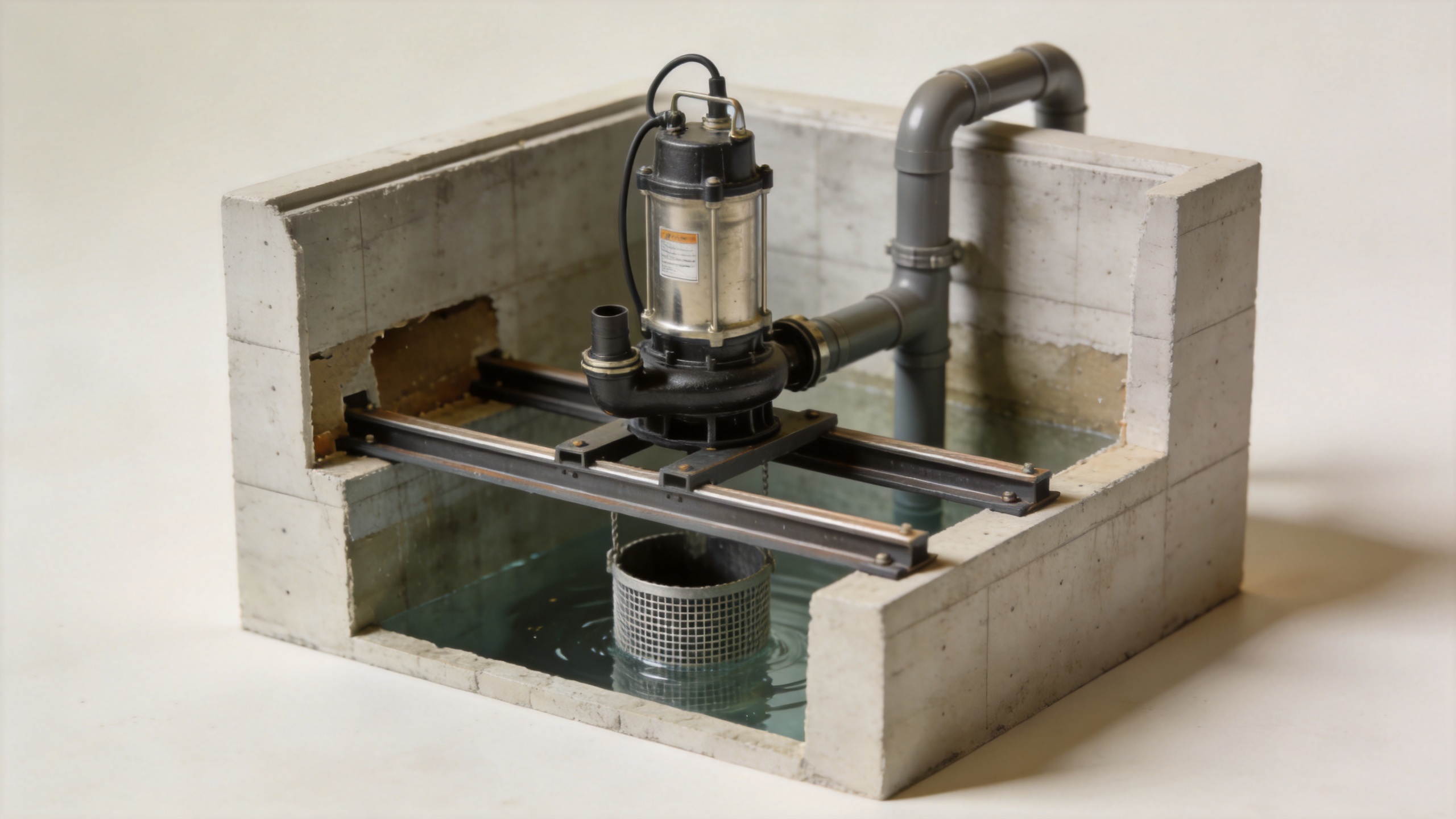
A submersible wastewater pump is part of an installation, not an isolated rotating machine. Consider guide rails, auto-coupling arrangement, discharge elbow, cable routing, lifting chain or cable, level sensors, non-return valves, isolation valves, ventilation, and safe access. A pump that can be lifted without entering the wet well may reduce service complexity, but the arrangement must suit the station layout and local safety procedures.
Control requirements also deserve early attention. Confirm motor voltage and phase, thermal protection, seal-leak monitoring, phase protection, control panel interfaces, alarm points, and whether variable-speed operation is intended. Variable speed can help match changing inflow, but it does not remove the need to verify minimum velocity, cooling conditions, and acceptable operation across the curve.
For wastewater treatment plant pumps, ask the operating team about the last difficult maintenance event. Was the issue ragging, abrasion, level-control failure, blocked pipework, seal damage, or restricted lifting access? That conversation often exposes an assumption that needs checking before a new submersible wastewater pump is ordered.
Compare lifecycle cost instead of purchase price alone
Use a comparison sheet that separates purchase, installation, operation, access, and service costs. This approach is especially useful for wastewater treatment plant pumps because a low upfront price can be outweighed by repeated callouts, energy use outside the preferred duty range, or difficult removal from the station. Do not claim savings without site evidence; instead, compare the factors that will drive the plant’s own cost.
- Document the duty point and full operating range.
- Record influent solids, fibrous content, grit exposure, and upstream treatment conditions.
- Compare hydraulic configuration, free passage, motor rating, materials, seals, and cable length.
- Review installation hardware, control protection, lifting access, and availability of spares.
- Agree how performance will be documented and accepted before the purchase order.
For centrifugal and other rotodynamic equipment, ISO 9906 is commonly referenced for hydraulic performance acceptance testing. The exact acceptance basis should be agreed with the supplier and matched to the project specification; it should not be inferred from a general catalog claim.
A practical selection checklist
Before requesting a quotation for a submersible wastewater pump, issue a concise data sheet containing flow, TDH, liquid temperature, pH or chemical exposure where relevant, solids description, expected free-passage need, sump dimensions, power supply, controls, installation arrangement, and service expectations. Include peak and abnormal conditions, not just average flow.
For wastewater treatment plant pumps, the most reliable purchase decision is usually the one with the fewest unresolved assumptions. Ask the supplier to identify any missing input rather than filling gaps with optimistic defaults. Then compare the documented solution by whole-system fit, performance evidence, and service practicality.
Conclusion
The right submersible wastewater pump selection begins with a disciplined picture of the process, medium, flow, head, and maintenance environment. Use the duty point to screen hydraulic options, use solids data to evaluate clogging risk, and use lifecycle considerations to compare technically viable alternatives. With those inputs confirmed, buyers can move from a broad product search to a pump specification that is easier to install, operate, and maintain.