 EN
What Is a Circulating Pump? Working Principle and Uses
A circulating pump is designed to keep a liquid moving around a loop rather than deliver it from one place to a separate destination. In many heating, cooling, hot-water, and solar-thermal systems, the same water or water-and-glycol mixture repeatedly travels through pipes, equipment, and back to the pump. The pump supplies the pressure difference needed to overcome friction and keep that loop moving.
For B2B buyers and system planners, the useful starting point is not simply “how powerful is the pump?” It is whether the circulating pump matches the fluid, temperature, pipe network, required flow, and resistance of the complete system. That distinction helps prevent a pump from being selected as if it were a transfer pump or a booster pump.
What Does a Circulating Pump Do?
A circulating pump, also called a circulator or circ pump, maintains flow in a closed or recirculating circuit. It commonly appears in hydronic heating, boiler loops, domestic hot-water recirculation, HVAC water loops, solar-thermal systems, process temperature control, and some equipment-cooling arrangements.
The pump does not create heat or cold by itself. Its job is to move the working fluid so that a boiler, heat exchanger, chiller, solar collector, or other piece of equipment can transfer energy where it is needed. For example, a hot-water heating loop relies on a circulating pump to move heated water from the heat source to terminal units and then back for reheating.
Because the fluid returns to the start of the loop, the system is different from a water-supply installation that lifts water from a tank or well. In a properly filled closed loop, the circulating pump mainly works against piping friction, valves, fittings, heat exchangers, and other flow restrictions. Elevation still matters for filling, pressure control, and component ratings, but it is not normally a continuous net lift requirement around a sealed loop.
How a Circulating Pump Works
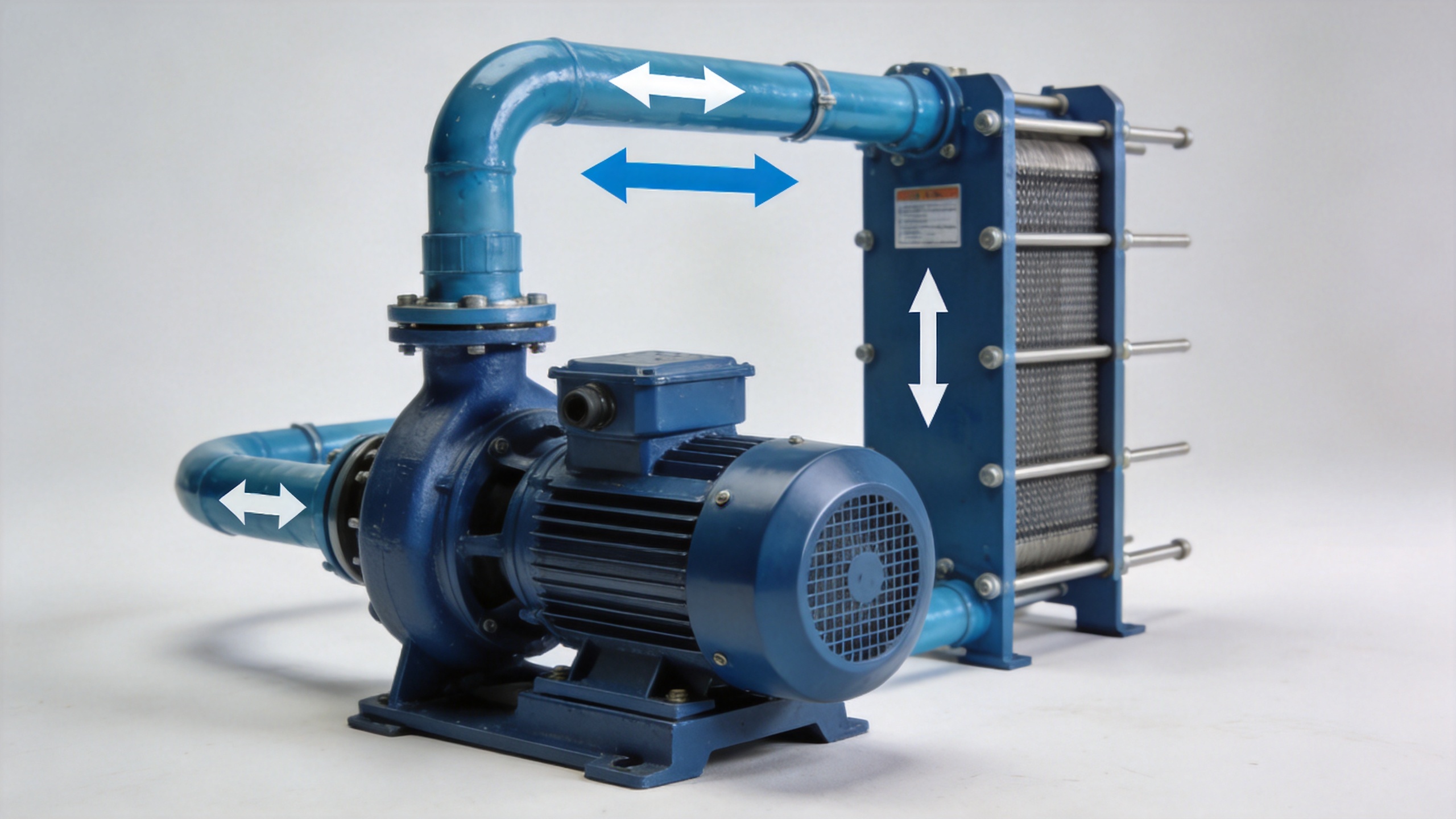
Most circulating pump designs use a motor and an impeller. When the motor turns the impeller, the rotating blades add velocity to the fluid. The pump casing then helps convert part of that velocity into pressure. That pressure difference pushes fluid out through the discharge side, across the system, and back through the return side.
- Fluid enters the pump: Water or a compatible fluid enters at the inlet or suction connection.
- The impeller transfers energy: The motor-driven impeller accelerates the fluid inside the casing.
- Pressure overcomes resistance: The resulting differential pressure moves fluid through pipes, valves, coils, and heat-transfer equipment.
- The loop returns fluid: The fluid comes back to the circulating pump and the cycle continues.
This simple operating principle is why pump selection should start with the required flow rate and the total resistance at that flow. A larger motor is not automatically a better solution. Excess head or flow can raise noise, increase energy use, disturb control valves, and create operating conditions that the system did not need.
Common Uses of a Circulating Pump
Hydronic heating and boiler systems
In hydronic heating, a circulating pump carries heated water between a boiler or heat source and radiators, baseboards, fan coils, or radiant-floor circuits. The flow rate must be appropriate for the equipment and distribution layout so heat can be delivered consistently.
Domestic hot-water recirculation
Domestic hot-water recirculation systems use a circulating pump to keep hot water moving through a return line. This can reduce the wait for hot water at distant fixtures when the system is designed, controlled, and insulated correctly. Water quality, local plumbing rules, material compatibility, and operating schedules all need review.
HVAC and cooling-water loops
Chilled-water and condenser-water systems may use circulation equipment to move water through coils, heat exchangers, and plant equipment. These applications can involve different temperatures, treatment programs, pipe sizes, and control methods, so the circulating pump must be considered as part of the full hydraulic system.
Solar-thermal and process loops
Solar-thermal circuits and industrial process loops often need circulation to move heat-transfer fluid between a collection or heat source and a storage tank or heat exchanger. Depending on the fluid and temperature range, material choice, seal design, and control strategy can be especially important.
Circulating Pump vs. Booster Pump
A circulating pump keeps fluid moving within a loop. A booster pump is generally used to increase pressure in a supply system so water can reach fixtures, upper floors, irrigation zones, or equipment that needs higher inlet pressure. The two pump types can both move water, but their duty conditions are not interchangeable.
| Question | Circulating Pump | Booster Pump |
|---|---|---|
| Typical purpose | Maintain flow in a recirculating loop | Raise pressure in a supply or distribution system |
| System layout | Often closed or returning loop | Usually open supply path to end users |
| Main selection focus | Flow and resistance through the loop | Required pressure, elevation, and demand conditions |
In multi-purpose water systems, the installation may include both types. The key is to define each duty point before selecting equipment.
How to Choose a Circulating Pump
Start with verified system information rather than a nameplate assumption. Before treating a circulating pump as a product-only question, review the actual flow demand, total dynamic resistance, fluid temperature, fluid chemistry, pipe size, and control arrangement. A system curve and pump curve comparison is the practical basis for selection.
- Required flow: Determine the flow needed by the heat-transfer or process equipment.
- Required head: Calculate resistance from pipe friction, fittings, valves, strainers, coils, and other components at the design flow.
- Fluid and temperature: Check whether the fluid is clean water, glycol mixture, or another compatible liquid, and confirm the operating temperature range.
- Materials: Consider corrosion exposure, water treatment, and whether the system is closed or open to oxygen.
- Controls: Decide whether fixed-speed, variable-speed, timer, thermostat, differential-pressure, or demand-based control is appropriate.
- Installation conditions: Verify electrical supply, connection orientation, service access, noise expectations, and local requirements.
For projects that also need water-circulation equipment, review the available high-building pressurized water circulation pump information alongside the confirmed duty conditions. The product page should support, not replace, engineering checks for the complete application.
Key Takeaway
A circulating pump is a compact but essential part of many fluid systems: it creates the differential pressure that keeps a working fluid moving around a loop. Its basic operation is straightforward, yet reliable results depend on matching flow, head, fluid, temperature, materials, and controls to the real system. When those conditions are clear, a circ pump can support stable circulation for heating, hot water, cooling, solar-thermal, and process applications.